
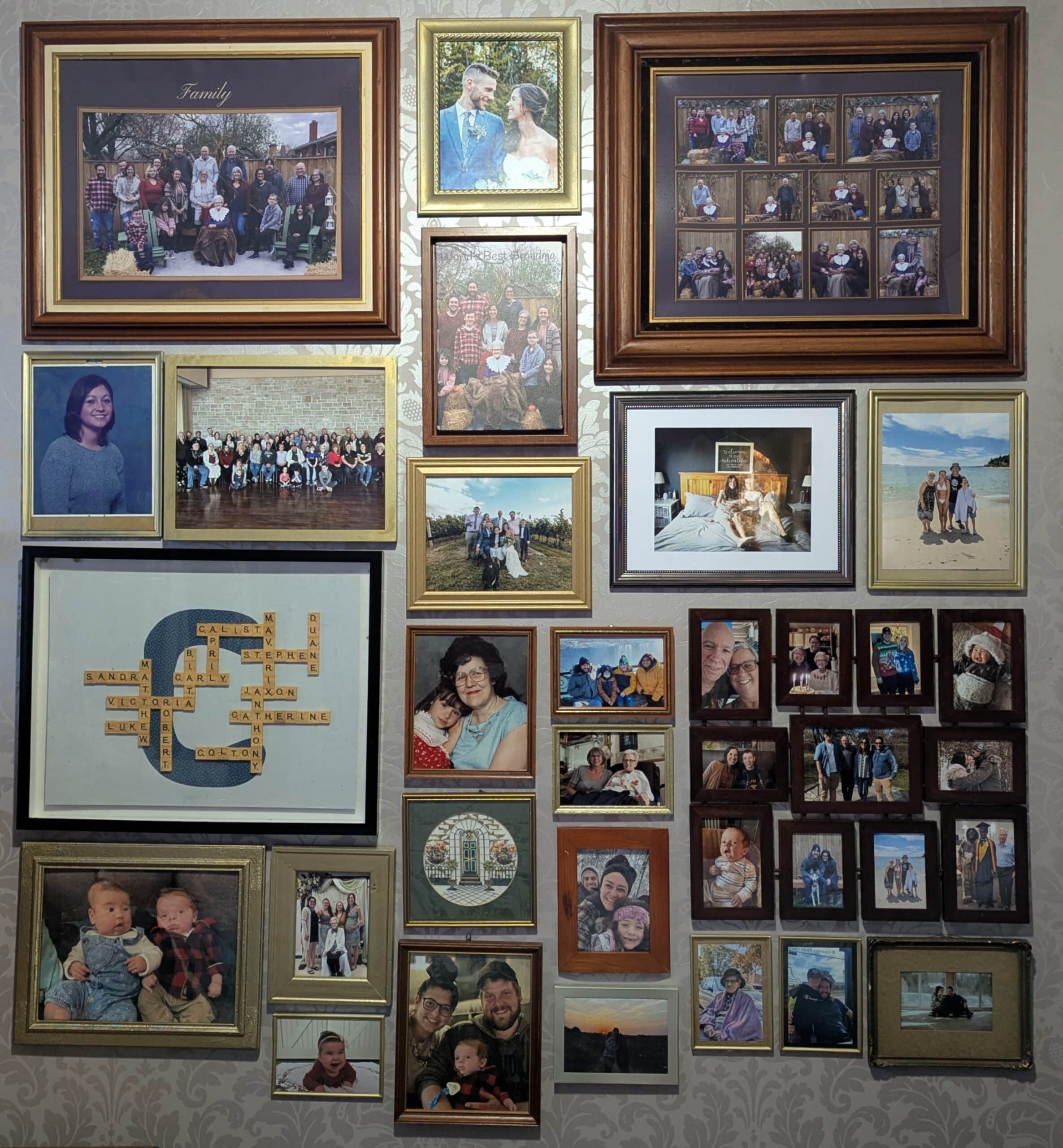
Family photo walls that feel curated, not cluttered
There’s something deeply grounding about walking past a photo and feeling your shoulders drop.
A tiny reminder of who you love. Where you’ve been. What matters.
And yet… family photos are one of the most common design “stuck points” I see.
People want warmth and meaning in their home, but they don’t want to create visual chaos. They don’t want frames scattered everywhere, competing colours, or a wall that feels more like a bulletin board than a beautiful part of the home.
If you’ve been thinking, “I want a photo wall, but I don’t want it to look cluttered,” you’re not alone.
A curated photo wall doesn’t require a huge budget or perfect photos. It requires intention and a simple plan.
Your home holds your story (whether you design for it or not)
Even if you’ve never thought of yourself as a “decorating person,” your home is already telling a story.
It shows what you prioritize, what you protect, what you’ve gathered, what you’re carrying, and what you’re ready for next.
That’s why photo walls can be so powerful. They’re not just décor. They create connections.
But for them to feel peaceful (not busy), you need one guiding idea: Let the wall be about feeling, not volume.
Curated doesn’t mean empty. It means edited.
What makes a photo wall feel cluttered?
Here are the usual culprits:
- Too many frame styles mixed together with no unifying element
- Random spacing (the “floating island” effect)
- Photos with lots of competing colours
- Frames that are too small for the wall size
- No anchor piece (so your eye has nowhere to rest)
- A mix of photos + quotes + art + kids’ drawings with no plan
- The biggest pet peeve is when the pictures are mounted well above eye level and you need a step ladder to even enjoy viewing it.
The good news: these are easy fixes once you know what you’re aiming for.
The goal: calm, intentional, and personal
A curated photo wall feels like:
- “This belongs here.”
- “This feels like us.”
- “This makes the space warmer.”
- “This feels finished.”
And it doesn’t have to be perfect. It just needs to feel purposeful.
Step 1: Choose the story before you choose frames
Before you measure or shop, decide what the wall is about.
Some examples:
- A season of life: newborn days, cottage summers, early years
- A place you love: cottage weekends, travel, your first home
- Generations: grandparents, heritage photos, family roots
- Everyday joy: simple moments, not just milestones
- A timeline: then-and-now pairs, years progressing
This decision helps you edit. Instead of “all the photos,” it becomes “this chapter.”
Step 2: Pick a layout style that matches your personality
Not everyone wants the same look. Here are three go-to styles that work beautifully:
a) The Grid
Clean, calm, structured. Great for modern homes or people who like order.
Best for: same-size frames, consistent spacing, a polished feel.
b) The Organic Gallery
Still curated, but more relaxed — like it evolved thoughtfully over time.
Best for: mixing sizes, combining photos + a little art, a warm lived-in feel.
c) The Anchor + Supporting Cast
One larger piece (or two) with a few smaller frames around it.
Best for: smaller walls, stairways, or anyone who wants “simple but intentional.”
If you’ve tried and abandoned a photo wall before, the anchor method is often the easiest to get right.
Step 3: Create a “unifier” so it feels curated
A photo wall looks cohesive when you choose one unifying element.
Pick one (or two) of these:
- Frame colour: all black, all white, all wood, or two-tone (black + wood)
- Matting: consistent white mats immediately makes things feel elevated
- Photo treatment: all black and white, or all colour with similar tones
- Theme: all candid lifestyle, all travel, all generations, etc.
If your photos are very colourful and varied, consider printing them in black and white. It’s the easiest “instant curator” trick.
Step 4: Size matters (more than people think)
One of the biggest reasons a photo wall feels cluttered is that the frames are too small for the wall.
A general guide:
- If the wall is large, include at least one or two larger frames (think 11×14, 16×20, or larger depending on scale).
- For stairways, Single photo frames with medium prints provide the best viewing as you make your way through the space. Think of 11 x 14 or 12 x 12 (all the same for a modern look) or a mix of large and small frames together 5×7 being the smallest.
- Stairway frames are best with the depth of 2” or less to ensure they aren’t protruding into the space..
- If the frames are tiny, you’ll need too many to fill the space, and it can start to look busy.
Curated usually means fewer pieces, better scaled.
Step 5: Plan it on the floor first (or on paper)
Before you put a single nail in the wall:
- Lay the frames on the floor and play with the arrangement
- Take a photo of each option so you can compare
- Aim for consistent spacing (often 2–3 inches between frames)
If you’re doing an organic gallery, a helpful rule is:
Keep the outer edges of the arrangement forming a soft rectangle or oval.
This keeps it from looking like frames “exploded” across the wall.
Step 6: Choose placement that supports real life
Photo walls aren’t only for hallways.
Some of the best places:
- Stairway walls (built-in movement makes it feel like a story unfolding)
- Bedroom (more personal, more calming)
- Family room (warm and connected)
- Entryway (a “welcome home” feeling)
- Upstairs hallway (quiet, sentimental, less “public”)
If you feel self-conscious about family photos being too front-and-center, choose a more private area. You’ll still enjoy them daily — without feeling like they’re “on display.”
A curated photo wall can change how your home feels
This might sound dramatic, but it’s true: the right photos in the right place can shift the emotional tone of a room.
They make a space feel warmer, more grounded, more “yours.”
And in a world that moves quickly, that kind of connection matters.
If you’re craving a home that feels more personal — not showroom-perfect — a photo wall is one of the simplest, most meaningful ways to start.
Need help making it feel cohesive?
If you’re overwhelmed by frame choices, spacing, or how to make it work with your existing décor, this is exactly the kind of project that’s easier with a calm plan.
Even small changes can make your home feel more connected to who you are — and help your space tell your story in a way that feels curated, not cluttered.
Reach out to me to discuss your options. Contact - April Lee Interior